Welding Equipment: Learn About Types, Functions and Industrial Applications
Welding Equipment includes the machines, tools, electrical components, protective systems, and accessories used to join metals through controlled heat, pressure, or a combination of both.
It is used across manufacturing, construction, automotive production, infrastructure, repair workshops, and metal fabrication. Different welding processes require different equipment, and the appropriate combination depends on the material, joint design, production environment, and required welding method.
Context
What Is Welding Equipment?
Welding equipment is a broad category covering the systems required to perform and control a welding operation. A basic setup may include a welding power source, welding torch or electrode holder, cables, work clamp, shielding arrangement, and personal protective equipment.
Some systems are designed for manual operation, while others can be integrated into mechanized or robotic production lines. The equipment must deliver the required electrical or mechanical conditions for the selected welding process.
How Welding Developed
Early metal-joining techniques relied heavily on heating and hammering metals together. The development of electrical power and controlled heat sources introduced new welding methods that could create joints with greater process control.
During the twentieth century, processes such as shielded metal arc welding, gas metal arc welding, gas tungsten arc welding, and resistance welding became established in industrial production. More recent developments have introduced electronic power control, sensors, automation, robotic movement, and digital monitoring.
How Welding Equipment Works
Many welding processes use an energy source to create sufficient heat for joining materials. In arc welding, an electrical arc forms between an electrode and the workpiece or between two electrodes, producing concentrated heat.
Some processes use a separate filler material to add metal to the joint. Shielding gas or flux can protect the heated region from atmospheric reactions that could affect the weld.
The general welding sequence involves:
- Preparing and positioning the workpieces
- Selecting the appropriate welding process
- Setting electrical or process parameters
- Establishing the required shielding conditions
- Creating the weld
- Allowing the joint to cool under controlled conditions
- Inspecting the finished weld
Major Types of Welding Equipment
Different welding methods require different equipment arrangements. Common categories include:
Shielded Metal Arc Welding (SMAW): Uses a consumable coated electrode and an arc between the electrode and workpiece.
Gas Metal Arc Welding (GMAW): Uses a continuously supplied wire electrode and shielding gas. It is commonly associated with automated and semi-automated welding.
Gas Tungsten Arc Welding (GTAW): Uses a non-consumable tungsten electrode and is often used where precise control of the weld is important.
Flux-Cored Arc Welding (FCAW): Uses a tubular wire containing flux. Some variations also use external shielding gas.
Resistance Welding: Uses electrical resistance and pressure to generate heat between contacting metal surfaces. Spot welding is a familiar example.
Submerged Arc Welding (SAW): Uses a continuously supplied electrode beneath a layer of granular flux and is commonly associated with larger industrial components.
Importance
Role in Manufacturing
Welding Equipment plays an important role in joining metal components into larger structures and assemblies. It is used to produce frames, vessels, machinery components, vehicle bodies, pipelines, structural elements, and numerous fabricated products.
The welding process must be matched with the material and joint requirements. Steel, stainless steel, aluminum alloys, and other metals can require different electrodes, shielding conditions, electrical parameters, and preparation methods.
Joint Strength and Process Control
A welded joint is affected by heat input, travel speed, current, voltage, electrode characteristics, shielding, joint preparation, and material properties. Incorrect parameters can contribute to defects such as porosity, incomplete fusion, undercut, cracking, or excessive distortion.
For this reason, welding is not simply a matter of applying heat to two pieces of metal. Controlled preparation, parameter selection, operator technique, and inspection all contribute to the resulting joint.
Applications Across Industries
Welding Equipment is used in many areas:
- Automotive manufacturing
- Heavy equipment production
- Building and structural fabrication
- Shipbuilding
- Railway equipment
- Energy infrastructure
- Agricultural machinery
- Metal component manufacturing
- Pipeline construction
- General fabrication
The equipment configuration can range from a manually operated power source to a coordinated robotic welding cell containing multiple sensors and motion systems.
Important Equipment Components
| Component | Main Function | Common Consideration |
|---|---|---|
| Welding power source | Generates required electrical output | Current and voltage range |
| Electrode holder or torch | Transfers energy to the weld area | Process compatibility |
| Welding cable | Carries electrical current | Capacity and insulation |
| Work clamp | Completes the electrical circuit | Secure connection |
| Shielding gas system | Protects the weld region | Gas type and flow |
| Wire feeder | Supplies welding wire | Feed speed and wire type |
| Welding helmet | Protects eyes and face | Appropriate filter rating |
| Ventilation system | Controls welding fumes | Workplace air movement |
Quality and Inspection
Weld inspection can involve visual examination, dimensional checks, and nondestructive testing. Depending on the application, methods such as ultrasonic testing, radiographic testing, magnetic particle testing, or liquid penetrant testing may be used.
The appropriate inspection method depends on the material, joint type, applicable specification, and potential defects being evaluated. Inspection does not replace correct process control; it is one part of a broader quality system.
Recent Updates
Digital Welding Controls
Modern Welding Equipment increasingly uses electronic control systems. Digital interfaces can allow operators to adjust parameters such as current, voltage, wire-feed speed, pulse characteristics, and other process variables.
Some systems can record operating information for later analysis. Digital records can also support process documentation where production procedures require traceability.
Automated and Robotic Welding
Automation is increasingly used where welding operations are repetitive or require consistent movement. Robotic systems can coordinate welding torches with programmed paths and production equipment.
Sensors and machine vision can also be integrated into selected systems. These technologies can help monitor joint position, weld conditions, or component alignment, depending on the system architecture.
Pulse and Advanced Arc Control
Electronic power sources have enabled more sophisticated control of welding arcs. Pulse-based techniques can regulate current in repeated cycles and may be used for particular materials, thicknesses, or joint conditions.
Advanced arc-control functions can also influence heat input, metal transfer, and arc stability. Their application depends on the welding process and equipment configuration.
Connected Manufacturing
Welding systems are increasingly connected to broader manufacturing networks. Equipment data may be transferred to production-monitoring platforms, quality databases, or manufacturing execution systems.
Connectivity can provide information about operating parameters, equipment status, production quantities, and process events. Networked equipment also requires appropriate access controls and cybersecurity practices.
Energy and Fume Management
Current industrial development also includes attention to electrical energy use and workplace exposure to welding fumes. Equipment design, process selection, extraction systems, and work practices can all influence workplace conditions.
Local exhaust ventilation and appropriate respiratory protection may be required depending on the materials and welding process. Fume composition varies with the base metal, coatings, filler material, shielding method, and process conditions.
Laws or Policies
Workplace Safety in India
Welding activities in India are subject to workplace safety requirements that can apply to industrial establishments and specific working environments. The Occupational Safety, Health and Working Conditions Code, 2020 forms part of India's broader framework for occupational safety.
Requirements can vary according to the establishment, state-level implementation, welding activity, materials, equipment, and workplace conditions. Employers and workers may need to follow applicable procedures for protective equipment, ventilation, electrical safety, fire prevention, and hazardous work.
Electrical and Machine Safety
Welding Equipment operates with electrical energy and may generate intense heat, sparks, ultraviolet radiation, fumes, and other hazards. Appropriate electrical protection, grounding, equipment inspection, and safe operating procedures are therefore important.
Relevant BIS and IEC standards may apply to welding equipment, electrical components, protective equipment, and related installations. The exact standards depend on the equipment category and intended application.
Environmental Considerations
Welding can generate fumes, gases, metal particles, noise, and waste materials. Industrial facilities may therefore need to follow environmental requirements administered through bodies such as the Central Pollution Control Board and relevant State Pollution Control Boards.
The Environment (Protection) Act, 1986 provides a broad environmental framework in India. Specific requirements depend on the facility, industrial activity, emissions, location, and applicable permissions.
Fire and Worker Protection
Welding areas require attention to combustible materials, sparks, hot surfaces, compressed gases, and electrical equipment. Appropriate fire-prevention procedures, cylinder handling practices, ventilation, protective clothing, eye protection, and workplace controls are part of safe welding operations.
Tools and Resources
Welding Calculators and Reference Tables
Technical calculators can help determine relationships between current, voltage, wire-feed speed, travel speed, heat input, and material thickness. Reference tables can also provide information about electrode classifications, shielding gases, and material compatibility.
These calculations should be interpreted alongside the applicable welding procedure and equipment documentation.
Inspection Tools
Common welding inspection tools include:
- Weld gauges for profile and dimensional checks
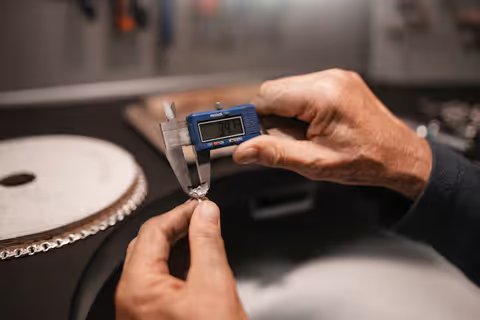
- Calipers for component measurements
- Temperature indicators for controlled preheating
- Magnifying equipment for visual inspection
- Ultrasonic instruments for selected internal examinations
- Magnetic particle equipment for suitable ferromagnetic materials
- Liquid penetrant materials for surface-defect examination
Technical Standards and Documentation
The American Welding Society publishes numerous welding standards and technical references. The International Organization for Standardization also publishes standards covering welding quality, qualification, testing, and terminology.
In India, the Bureau of Indian Standards provides access to applicable Indian standards. Equipment manuals, welding procedure specifications, material certificates, inspection records, and maintenance documentation are also important technical resources.
FAQs
What is Welding Equipment?
Welding Equipment refers to the machines, tools, electrical components, protective equipment, and accessories used to perform welding operations. The configuration varies according to the welding process and material.
What are the main types of Welding Equipment?
Common categories include equipment for SMAW, GMAW, GTAW, FCAW, resistance welding, and submerged arc welding. Each process uses different combinations of power sources, electrodes, torches, shielding systems, or mechanical equipment.
How do I choose Welding Equipment for metal?
Selection depends on material type, thickness, joint design, welding position, production method, electrical requirements, shielding requirements, and applicable welding procedures. Equipment specifications should correspond with the intended process.
Why is shielding gas used in welding?
Shielding gas can protect the heated weld region from atmospheric gases that may affect the welding process. Different welding processes and materials use different shielding arrangements.
What safety equipment is used during welding?
Common protective equipment includes a suitable welding helmet, protective clothing, gloves, safety footwear, and appropriate eye protection. Ventilation and respiratory protection may also be required depending on the welding materials and workplace conditions.
Conclusion
Welding Equipment encompasses power sources, electrodes, torches, cables, shielding systems, protective equipment, and inspection tools used in metal joining. Different welding processes have distinct equipment and parameter requirements, with applications ranging from manufacturing and construction to automotive and infrastructure work. Recent developments include digital controls, robotic welding, process monitoring, connected systems, and improved fume-management approaches. Safe and controlled welding depends on suitable equipment, trained operation, appropriate inspection, and compliance with applicable workplace and technical requirements.