AI Warehouse Automation Guide: Selecting Systems for Ecommerce, Retail, and 3PL Operations
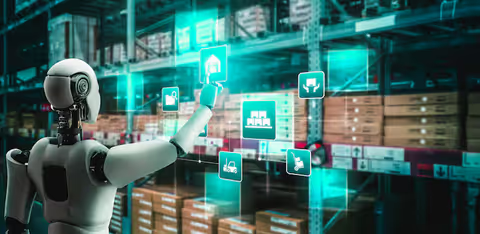
AI warehouse automation combines robotics, intelligent software, real-time data, and decision-making to improve picking, sorting, storage, inventory accuracy, and fulfillment speed.
The right system depends on your order profile, SKU mix, peak volumes, available space, and need for flexibility—not simply on the most advanced robot.
What Is AI Warehouse Automation?
AI warehouse automation uses data and algorithms to direct people, robots, conveyors, and storage systems more efficiently. It can prioritize work, predict demand, optimize picking routes, identify bottlenecks, and recommend actions during peak periods.
A modern automated warehouse typically includes:
Warehouse Management System (WMS): The system of record for inventory, orders, locations, and warehouse tasks.
Warehouse Execution System (WES): Coordinates work across labor, robots, conveyors, and sortation systems.
AI and analytics layer: Forecasts demand, prioritizes tasks, detects anomalies, and recommends improvements.
Physical automation: Autonomous mobile robots, shuttles, conveyors, sorters, automated storage, and picking systems.
Integration layer: Connects the WMS, ERP, ecommerce platform, transportation system, and automation equipment.
The WMS should remain the source of truth for inventory and orders, while the execution layer decides how work is sequenced and routed across available resources.
Core Automation Technologies
| Technology | What It Does | Best Use Case |
|---|---|---|
| Autonomous Mobile Robots (AMRs) | Transport totes, shelves, or pallets to workers | Flexible fulfillment and changing layouts |
| Automated Storage and Retrieval Systems (AS/RS) | Store and retrieve goods using shuttles, cranes, or vertical lifts | High-density storage and stable high-volume operations |
| Goods-to-Person systems | Bring items or totes to a stationary picker | High-SKU ecommerce and retail fulfillment |
| Conveyor and sortation systems | Move and route orders automatically | High-volume outbound processing |
| Robotic picking arms | Pick individual items using vision and grippers | Suitable SKU profiles and repetitive picking tasks |
| Automated packing systems | Box, seal, label, or verify orders | High-volume ecommerce packing |
| Voice and mobile workflows | Guide workers through tasks | Labor-intensive picking and receiving |
| AI vision and scanning | Verify items, detect damage, and reduce errors | Quality control and returns processing |
AI Capabilities That Matter
AI adds value when it improves decisions, not just when it moves products.
Key capabilities include:
Demand forecasting: Predicts SKU demand by season, promotion, channel, and location.
Dynamic slotting: Places fast-moving SKUs closer to pick zones.
Intelligent task allocation: Assigns work to the best available worker, robot, or zone.
Route optimization: Reduces travel time and improves pick density.
Exception management: Flags inventory mismatches, damaged goods, delayed orders, and failed scans.
Labor forecasting: Helps schedule staff for expected order volume.
Predictive maintenance: Identifies equipment issues before they cause downtime.
Returns intelligence: Identifies return reasons, fraud risks, and restocking opportunities.
AI should support operators and supervisors with clear recommendations, while critical decisions remain auditable and controllable.
Selecting for Ecommerce
Ecommerce operations usually handle many small orders, high SKU variety, frequent promotions, and tight delivery promises. The priority is accurate piece picking, fast packing, and reliable order status updates.
Best-fit systems often include:
Goods-to-person picking systems
AMRs that bring totes or shelves to workers
Automated storage for high-velocity SKUs
Conveyor and sortation systems for outbound orders
Automated packing and label verification
Returns processing automation
For ecommerce, choose systems that can handle peak-season surges without requiring a full facility redesign. AMRs and modular goods-to-person systems are often easier to scale incrementally than large fixed installations.
Selecting for Retail
Retail distribution centers often manage high SKU counts, seasonal demand, store replenishment, bulk handling, and returns. The goal is to balance store-ready presentation, accurate replenishment, and efficient use of space.
Best-fit systems often include:
AS/RS for dense storage of stable, high-volume inventory
AMRs for flexible transport and replenishment
Conveyor systems for case handling and store-ready sorting
Automated palletizing and depalletizing
Vision systems for carton integrity and label verification
Returns processing systems for apparel and seasonal merchandise
For apparel and retail, high SKU counts and seasonality make flexible systems such as grid-based goods-to-person and AMR deployments particularly relevant.scr
Selecting for 3PL Operations
Third-party logistics providers must serve multiple clients with different products, order profiles, service levels, and billing rules. Flexibility, multi-client visibility, and rapid onboarding matter more than maximizing density for one product type.
Best-fit systems often include:
AMRs for adaptable transport across changing client needs
Zone picking and batch picking for small items
AMR-supported pick-to-tote workflows for high runners
Modular conveyors and sortation
Multi-tenant WMS with client-specific workflows and billing
Configurable service-level and exception rules
Client portals with real-time inventory and order visibility
For 3PLs, map each major process by touch count, travel time, and error rate. Then choose automation that reduces one or more of those drivers while preserving flexibility across clients.cleverence
Build the Right Software Foundation
Automation fails when the underlying data and workflows are weak. Improve or upgrade the WMS before deploying robots, because robots depend on accurate inventory, locations, order priorities, and task data.
Your software stack should provide:
Real-time inventory visibility
Accurate bin and location data
Order prioritization rules
Wave, batch, and zone picking logic
API-based integration with ERP, ecommerce, carriers, and automation vendors
Exception handling and audit trails
Multi-site and multi-client support for 3PLs
Real-time dashboards for throughput, labor, errors, and SLA performance
Strong cybersecurity and role-based access controls
Evaluate the warehouse execution and orchestration software, WMS/ERP integration, and multi-vendor interoperability—not just the robots.scr
Evaluate Throughput and Scalability
Model performance using your own historical and projected data, including peak-season volumes, SKU complexity, order profiles, and labor availability.
Calculate:
Orders per hour
Lines picked per hour
Units per hour
Picking accuracy
Inventory accuracy
Dock-to-stock time
Order cycle time
On-time shipment rate
Labor hours per order
Cost per order
Storage density
System availability and downtime
AMRs often scale in smaller increments, while AS/RS systems may scale in larger steps but can provide higher storage density and predictable cycle times for stable, fast-moving inventory.scr+1
Compare Ownership Models
| Model | Upfront Cost | Flexibility | Best For |
|---|---|---|---|
| Capital purchase | High | High long-term control | Stable, long-term operations |
| Robotics-as-a-Service | Lower upfront | Subscription-based scaling | Variable demand and uncertain growth |
| Leasing | Moderate | Fixed-term commitment | Businesses preserving capital |
| Hybrid model | Moderate | Combines owned and rented capacity | Seasonal peaks and phased expansion |
Model total cost using your own data, including software, integration, maintenance, spare parts, training, facility changes, and potential Robotics-as-a-Service options.scr
Run a Pilot Before Scaling
A pilot should test the system under realistic conditions, not only in a supplier demonstration environment.
Pilot checklist:
Use your actual SKUs, cartons, totes, and order profiles.
Test peak-hour throughput, not just average daily volume.
Validate WMS, ERP, and automation integrations.
Measure error rates, exception handling, and recovery procedures.
Test network coverage, battery charging, and safety systems.
Involve warehouse staff in workflow design and training.
Establish clear success criteria before the pilot begins.
Compare results against a control area or manual baseline.
Request demonstrations using your actual inventory items rather than idealized scenarios, and define KPIs that connect directly to WMS and operational metrics.finaleinventory
Implementation Roadmap
Map current operations: Identify picking, packing, receiving, replenishment, returns, and outbound bottlenecks.
Clean your data: Improve SKU data, locations, inventory accuracy, and order priorities.
Define requirements: Set throughput, accuracy, storage density, peak capacity, and integration needs.
Choose a pilot area: Start with a high-impact process such as piece picking or returns.
Select a vendor: Prioritize integration capability, scalability, support, and proven experience in your industry.
Run a controlled pilot: Validate performance with real orders and real exceptions.
Train staff: Prepare operators, supervisors, maintenance teams, and IT staff.
Scale in phases: Add robots, zones, or modules as volume and confidence grow.
Monitor continuously: Track ROI, service levels, labor productivity, and system reliability.
Common Mistakes to Avoid
Automating an inefficient process instead of improving it first.
Choosing robots before ensuring WMS data quality.
Designing for average volume rather than peak demand.
Ignoring exception handling, returns, damaged goods, and inventory discrepancies.
Selecting a system that cannot scale with changing SKU profiles.
Underestimating integration, training, maintenance, and change-management costs.
Failing to involve warehouse staff early.
Buying fixed automation when flexibility is more important than density.
Best Practices
Start with a focused, high-impact pilot rather than a full-facility transformation.
Keep the WMS as the inventory and order system of record.
Use AI to support decisions, not to remove human oversight entirely.
Design workflows around safety, ergonomics, and exception handling.
Choose modular systems when demand is uncertain.
Establish clear KPIs before deployment.
Review performance after peak season and adjust capacity accordingly.
AI warehouse automation delivers the best results when software, physical systems, people, and processes work together. Ecommerce businesses should prioritize flexible piece-picking and scalable fulfillment; retail should focus on storage density, replenishment, and returns; and 3PLs should prioritize multi-client flexibility, integration, and configurable service levels.