Industrial Ventilation Equipment Manufacturing: An Informative Guide
Industrial ventilation equipment manufacturing involves the design, fabrication, assembly, testing, and inspection of equipment used to move, control, filter, heat, cool, or remove air and airborne contaminants in industrial environments.
Common equipment includes industrial fans, blowers, air-handling units, dust collectors, exhaust systems, ducting, louvers, dampers, and filtration units.
The need for controlled ventilation developed alongside industrial production, where enclosed workplaces began generating heat, dust, smoke, vapors, fumes, and other airborne materials. Early ventilation arrangements relied heavily on natural airflow and basic mechanical fans. As factories became larger and production processes more complex, engineered systems became necessary to manage airflow more precisely.
Modern industrial ventilation equipment manufacturing combines mechanical engineering, fluid dynamics, materials science, electrical controls, filtration technology, and workplace safety principles. Equipment is generally designed around factors such as airflow volume, pressure, temperature, contaminant characteristics, humidity, available space, energy use, and the operating environment.
Main Types of Industrial Ventilation Equipment
Different industrial processes require different methods of air movement and contaminant control. Some systems focus primarily on general air circulation, while others capture airborne material close to its source.
Common categories include:
- Axial fans for moving large air volumes along the direction of the fan shaft.
- Centrifugal fans for generating airflow through a rotating impeller and pressure difference.
- Industrial blowers for applications requiring controlled air movement and pressure.
- Dust collectors for separating particulate matter from an air stream.
- Fume extraction systems for capturing fumes near manufacturing processes.
- Air-handling units for conditioning and distributing air within industrial buildings.
- Dampers and louvers for controlling airflow through ducts and openings.
- Industrial ducting for transporting air between equipment and work areas.
How Manufacturing Takes Place
Industrial ventilation equipment manufacturing normally begins with an assessment of the intended operating conditions. Engineers determine airflow requirements, pressure conditions, material compatibility, temperature ranges, installation constraints, and control requirements before equipment dimensions and components are finalized.
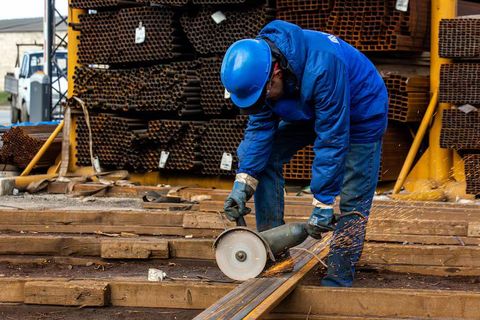
Manufacturing may involve sheet-metal cutting, forming, welding, machining, coating, assembly, balancing, electrical integration, and inspection. Fans and rotating components may undergo balance checks, while ducts and enclosures are examined for dimensional accuracy and leakage-related issues.
Importance
Industrial ventilation affects workplace conditions, production environments, equipment reliability, and indoor air quality. Poorly controlled air movement can allow heat, dust, fumes, moisture, or process-generated contaminants to accumulate in areas where people work or machinery operates.
Industrial ventilation equipment manufacturing therefore plays a role in creating systems that can move air according to a defined process requirement. Proper airflow can also help maintain controlled conditions for manufacturing operations where temperature, humidity, or airborne particles influence production.
Workplace and Process Applications
Industrial ventilation systems are used across many sectors. Manufacturing plants may use extraction equipment around welding, grinding, cutting, painting, chemical processing, or material handling areas.
Other applications include:
- Food and beverage production
- Pharmaceutical and biotechnology facilities
- Chemical processing plants
- Metalworking facilities
- Automotive manufacturing
- Electronics production
- Cement and mineral processing
- Warehouses and large industrial buildings
- Laboratories and controlled production areas
Each environment presents different ventilation requirements. For example, a system handling abrasive dust may require different materials and filtration arrangements from one designed for warm, humid air.
Important Design Factors
Several variables influence industrial ventilation equipment manufacturing. Airflow is usually expressed as a volume of air moved over a specific period, while pressure indicates the resistance the equipment must overcome.
Other considerations include:
- Air temperature and humidity
- Particle size and concentration
- Chemical compatibility
- Noise levels
- Equipment footprint
- Electrical requirements
- Maintenance access
- Fire and explosion considerations
- Corrosion exposure
- Filtration requirements
A ventilation system also depends on the surrounding ductwork, dampers, filters, hoods, and discharge arrangements. The fan or blower cannot be evaluated independently from the complete airflow path.
Equipment Comparison
| Equipment | Main Function | Typical Application | Important Consideration |
|---|---|---|---|
| Axial fan | Moves high air volume | General ventilation | Airflow and pressure |
| Centrifugal fan | Moves air against resistance | Extraction and process systems | Static pressure |
| Dust collector | Removes particulates | Grinding and material handling | Filter characteristics |
| Fume extractor | Captures process fumes | Welding and chemical processes | Capture location |
| Air-handling unit | Conditions and distributes air | Industrial buildings | Temperature and filtration |
| Damper | Regulates airflow | Duct networks | Control position |
| Louver | Controls air entry or discharge | Building ventilation | Weather and airflow |
Recent Updates
Recent developments in industrial ventilation equipment manufacturing have focused on improved monitoring, automation, energy management, filtration, and equipment integration. Digital controls are increasingly connected with sensors that measure airflow, pressure, temperature, vibration, and filter conditions.
Digital Monitoring and Automation
Modern ventilation systems can incorporate variable-frequency drives, programmable controllers, sensors, and human-machine interfaces. These components allow fan speed and airflow conditions to be adjusted according to operating requirements.
Sensor-based monitoring can also provide information about pressure changes across filters, motor conditions, and abnormal vibration. Historical data can help maintenance teams identify changes in equipment behavior.
Energy Management
Fan systems can consume significant electrical energy when operating continuously. Variable-speed control allows airflow to change according to process requirements rather than maintaining one fixed operating condition.
Designers are also examining fan blade geometry, motor efficiency, duct layouts, pressure losses, and filtration arrangements as part of overall energy management. Reducing unnecessary resistance in an airflow system can influence the amount of energy required for operation.
Advanced Filtration
Filtration technology continues to develop for environments where fine particles, fumes, aerosols, or other airborne materials must be controlled. Filter selection depends on particle characteristics, airflow volume, pressure drop, operating temperature, and the required level of separation.
Digital pressure monitoring across filters is also becoming more common. A rising pressure difference can indicate increasing filter loading and can help indicate when inspection or replacement should be considered.
Connected Ventilation Systems
Industrial ventilation equipment manufacturing is increasingly linked with broader industrial automation. Ventilation data may be integrated into SCADA, building management, or plant monitoring platforms.
Connectivity can improve visibility into equipment operation, although networked systems also require appropriate cybersecurity controls. Access management, network segmentation, software maintenance, and data protection are relevant considerations for connected industrial equipment.
Laws or Policies
In India, industrial ventilation systems are influenced by workplace safety, environmental protection, electrical safety, building requirements, and pollution-control regulations. The exact requirements depend on the industry, facility, equipment type, and materials handled.
Workplace Safety
The Occupational Safety, Health and Working Conditions Code, 2020 provides a broad legislative framework for occupational safety and working conditions. Industrial facilities may also need to follow applicable rules concerning hazardous processes, worker protection, machinery, ventilation, and workplace conditions.
Ventilation arrangements can be particularly important where manufacturing processes generate dust, fumes, gases, vapors, heat, or other airborne hazards.
Environmental Controls
The Ministry of Environment, Forest and Climate Change, Central Pollution Control Board, and relevant State Pollution Control Boards are involved in environmental regulation in India. Industrial facilities may have requirements concerning air emissions, particulate matter, exhaust systems, and pollution-control equipment depending on their activities.
Where ventilation equipment is connected to an emission-control system, the overall installation may need to be considered as part of the facility's environmental-control arrangement.
Standards and Electrical Safety
Bureau of Indian Standards publications and relevant IEC standards can provide technical references for electrical equipment, fans, motors, control systems, safety practices, and related components. Specific standards depend on the equipment category and application.
Facilities handling flammable or combustible materials may also need additional precautions relating to ignition sources, hazardous areas, equipment construction, and electrical installations.
Tools and Resources
Several engineering and measurement tools are used throughout industrial ventilation equipment manufacturing and system evaluation.
Design and Calculation Tools
Computer-aided design software can be used to create fan housings, ducts, supports, enclosures, and equipment layouts. Computational fluid dynamics tools can model airflow patterns and pressure behavior in more complex systems.
Airflow calculations commonly consider:
- Air volume
- Duct dimensions
- Air velocity
- Pressure loss
- Fan operating point
- Filter resistance
- System configuration
Measurement Equipment
Practical testing may involve anemometers, differential-pressure instruments, tachometers, vibration meters, sound-level meters, temperature sensors, and electrical measurement instruments.
For larger installations, airflow testing and balancing procedures can help compare actual system behavior with the intended design conditions.
Reference Resources
Useful information can be obtained from:
- Bureau of Indian Standards publications
- Central Pollution Control Board resources
- Ministry of Environment, Forest and Climate Change publications
- State Pollution Control Board guidance
- Occupational safety regulations
- IEC technical standards
- Fan and motor engineering manuals
- CAD and computational fluid dynamics documentation
- Industrial ventilation design references
Technical documentation should be interpreted according to the specific equipment, facility, and regulatory environment.
FAQs
What is industrial ventilation equipment manufacturing?
Industrial ventilation equipment manufacturing is the process of designing, fabricating, assembling, testing, and inspecting equipment used to move, control, filter, or remove air in industrial environments.
What equipment is used in industrial ventilation systems?
Common equipment includes axial fans, centrifugal fans, blowers, dust collectors, fume extraction units, air-handling units, dampers, louvers, filters, and industrial ducting.
Why is industrial ventilation equipment important?
Industrial ventilation equipment helps control airflow, heat, dust, fumes, moisture, and other airborne materials generated by industrial processes. Its design depends on the characteristics of the workplace and the process.
What factors influence industrial ventilation equipment manufacturing?
Important factors include airflow volume, pressure, temperature, humidity, contaminant characteristics, material compatibility, filtration requirements, noise, electrical conditions, space, and maintenance access.
How is industrial ventilation equipment monitored?
Modern systems can use airflow sensors, pressure instruments, temperature sensors, vibration monitoring, variable-frequency drives, programmable controllers, and plant monitoring platforms to observe operating conditions.
Conclusion
Industrial ventilation equipment manufacturing combines mechanical design, airflow engineering, fabrication, filtration, controls, and testing to create equipment for controlled industrial air movement. Its applications range from general factory ventilation to localized dust and fume extraction. Recent developments have emphasized digital monitoring, variable-speed operation, advanced filtration, and integration with industrial automation. In India, workplace safety, environmental regulation, electrical requirements, and applicable technical standards all contribute to how ventilation systems are designed and operated.