Industrial Lifting Equipment: A Guide to Types, Functions and Operating Methods
Industrial lifting equipment refers to mechanical and powered systems used to raise, lower, position, move, or suspend heavy materials in workplaces.
These systems are common in manufacturing plants, warehouses, construction sites, ports, workshops, power facilities, and infrastructure projects. Industrial lifting equipment includes cranes, hoists, lifting tables, winches, jacks, forklifts, overhead systems, and various lifting accessories.
The basic purpose of this equipment is to handle loads that cannot be moved efficiently or safely through direct manual effort. Different machines are designed for different load capacities, lifting heights, movement patterns, and working environments. Correct equipment selection also depends on the characteristics of the load and the conditions in which lifting takes place.
Context
What Is Industrial Lifting Equipment?
Industrial lifting equipment includes machines and mechanical systems that use electrical, hydraulic, pneumatic, mechanical, or manual power to move loads vertically or horizontally. Some systems lift a load and keep it suspended, while others combine lifting with movement across a floor, work area, or overhead path.
A complete lifting arrangement may contain several components:
Main lifting machine
Hoist or lifting mechanism
Chains, wire ropes, or synthetic lifting elements
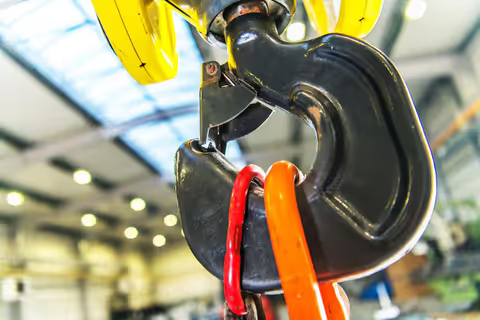
Hooks and connecting devices
Slings and lifting attachments
Brakes and load-control mechanisms
Limit switches and safety controls
Structural support systems
Each component has a specific role. The lifting machine alone does not determine the safe working capacity of the complete arrangement.
Development of Industrial Lifting Systems
Early lifting methods relied on levers, pulleys, ropes, ramps, and other mechanical principles. As industrial production expanded, larger cranes, hoists, and powered lifting systems were developed to handle heavier machinery and materials.
Electric motors, hydraulic systems, improved brakes, stronger structural materials, and electronic controls later changed industrial lifting equipment. Modern systems can combine mechanical lifting mechanisms with sensors, programmable controls, remote operation, and digital monitoring.
Main Types of Lifting Equipment
Industrial lifting equipment can be grouped according to its movement, lifting mechanism, and application.
Common categories include:
Overhead cranes for lifting and moving loads along elevated runways
Gantry cranes supported by legs that travel on ground-level tracks or surfaces
Jib cranes with a projecting horizontal arm
Electric and manual hoists for controlled vertical lifting
Wire-rope hoists for heavier lifting applications
Chain hoists for various industrial handling tasks
Hydraulic lifting tables for raising materials to working heights
Winches for pulling or lifting loads through cable or rope systems
Forklifts for lifting and transporting palletized materials
Hydraulic jacks for raising machinery and other heavy objects
The equipment type should correspond to the required lifting height, load characteristics, travel path, operating environment, and applicable safety requirements.
Importance
Handling Heavy Materials
Industrial lifting equipment reduces the need for workers to manually move heavy machinery, components, raw materials, and finished products. This is particularly important in factories where large objects must be positioned repeatedly.
Examples include moving steel components, machinery parts, production molds, containers, pipes, electrical equipment, and maintenance components.
Supporting Manufacturing
Manufacturing plants often require lifting equipment at multiple stages of production. Cranes may move large components between workstations, while hoists can position equipment during assembly or maintenance.
The equipment used depends on the factory layout. Overhead systems can move loads without occupying the same floor space used by vehicles or production equipment.
Warehouse and Material Handling
Warehouses use forklifts, lifting tables, stackers, pallet-handling equipment, and other systems to move materials vertically and horizontally. Load dimensions, aisle width, floor conditions, and storage height all influence equipment selection.
Poorly planned material movement can create congestion and increase the possibility of collisions or load instability. Layout planning is therefore an important part of lifting operations.
Construction and Infrastructure
Construction projects use cranes, hoists, winches, jacks, and lifting accessories to position structural components and machinery. The equipment must account for changing site conditions, load paths, ground conditions, wind exposure, and available working space.
The following table provides a general comparison of common equipment categories.
| Equipment type | Main movement | Typical application | Power method |
|---|---|---|---|
| Overhead crane | Vertical and horizontal | Factory material handling | Electric |
| Gantry crane | Vertical and horizontal | Yards and workshops | Electric or manual |
| Jib crane | Vertical with limited horizontal movement | Workstations | Electric or manual |
| Chain hoist | Mainly vertical | Assembly and maintenance | Manual or electric |
| Wire-rope hoist | Mainly vertical | Heavy industrial lifting | Electric |
| Forklift | Vertical and horizontal | Warehouse handling | Electric, gas, or diesel |
| Hydraulic lift | Mainly vertical | Equipment positioning | Hydraulic |
| Winch | Pulling and lifting | Construction and industrial work | Electric or hydraulic |
Actual configurations vary according to manufacturer design and application requirements.
Load Control and Stability
Lifting is not simply a matter of raising a load. The center of gravity, attachment points, sling angles, load dimensions, surface conditions, and movement speed can all influence stability.
Operators and supervisors need to understand the rated capacity of the equipment and the lifting arrangement being used. Loads should not exceed the applicable rated capacity, and damaged lifting components should not be placed into operation.
Recent Updates
Automation and Remote Operation
Recent developments in industrial lifting equipment increasingly involve automation and remote controls. Sensors, programmable systems, cameras, and communication networks can support monitoring and coordinated movement.
Some modern crane systems can use positioning information to control travel paths and reduce unintended movement. Automated systems remain dependent on appropriate configuration, inspection, and human oversight.
Load Monitoring
Electronic load monitoring systems are increasingly integrated into lifting equipment. Load cells and related sensors can measure or estimate lifting loads and provide information through digital displays or control systems.
Monitoring can also extend to operating hours, overload events, motor conditions, brake status, and other equipment parameters. The available information depends on the equipment design.
Electrification
Electric lifting equipment continues to expand in applications where indoor operation, controlled movement, and reduced local exhaust emissions are important. Battery-powered equipment is also being used in selected material-handling environments.
Energy requirements vary considerably between equipment categories. Factors such as lifting capacity, duty cycle, travel distance, battery size, and charging arrangements influence actual energy use.
Predictive Equipment Monitoring
Digital condition monitoring is increasingly used for industrial lifting systems. Sensors can record vibration, temperature, motor current, brake activity, and other operating characteristics.
The collected information can help maintenance teams identify changes in equipment behavior. It does not replace physical inspection, statutory examinations, or manufacturer maintenance procedures.
Improved Safety Controls
Modern lifting systems may incorporate emergency-stop controls, overload protection, limit switches, anti-collision systems, cameras, warning systems, and controlled acceleration or braking.
The combination of these technologies varies by crane, hoist, forklift, and workplace. Safety controls must be maintained and tested according to applicable requirements.
Laws or Policies
Workplace Safety in India
Industrial lifting operations in India are influenced by occupational safety legislation, factory requirements, technical standards, and state-level rules. The Occupational Safety, Health and Working Conditions Code, 2020 provides a broad framework for workplace health and safety, subject to applicable implementation provisions.
Factories and industrial facilities may also need to follow requirements concerning machinery guarding, worker training, workplace conditions, inspection, and lifting operations.
Lifting Equipment Inspection
Lifting equipment generally requires appropriate examination and inspection based on its type, use, workplace conditions, and applicable regulations or standards. Records may document inspections, tests, defects, repairs, and equipment identification.
The responsible authority and inspection interval can differ according to equipment type and jurisdiction. Facility operators should verify the requirements applicable to their location and equipment category.
Indian Standards
The Bureau of Indian Standards publishes standards relevant to cranes, lifting appliances, wire ropes, hooks, slings, and related equipment. Applicable standards depend on the particular machine and component.
Technical standards can address structural design, testing, dimensions, safety factors, operating conditions, and inspection practices.
Environmental and Electrical Requirements
Electrically powered lifting equipment must also consider applicable electrical safety requirements. Battery systems, charging areas, diesel-powered equipment, hydraulic fluids, lubricants, and other materials may create additional environmental or workplace considerations.
Facilities should follow applicable rules for electrical installations, waste handling, emissions, and hazardous materials where relevant.
Tools and Resources
Load-Capacity Calculations
Load charts and capacity tables are important resources for lifting operations. They can provide information about rated capacity under specific conditions, including boom length, lifting radius, configuration, or attachment type.
For crane and hoist operations, capacity information should be taken from the equipment documentation rather than estimated from appearance or general machine dimensions.
Inspection Checklists
A lifting-equipment inspection checklist can include:
Equipment identification
Rated capacity
Hooks and latches
Wire ropes or chains
Brakes
Limit switches
Structural components
Electrical controls
Emergency controls
Warning indicators
Signs of wear or deformation
Inspection requirements vary by equipment category and applicable regulations.
Digital Monitoring Platforms
Industrial facilities may use maintenance-management systems to record inspection dates, equipment history, operating hours, repairs, and component replacements.
Manufacturer manuals, engineering drawings, load charts, BIS standards, and government safety resources are also useful references for understanding equipment requirements.
FAQs
What is industrial lifting equipment used for?
Industrial lifting equipment is used to raise, lower, position, and move heavy materials or machinery. Common applications include manufacturing, construction, warehouses, ports, workshops, power facilities, and maintenance operations.
What are the main types of industrial lifting equipment?
Common types include overhead cranes, gantry cranes, jib cranes, chain hoists, wire-rope hoists, winches, hydraulic lifts, lifting tables, forklifts, and hydraulic jacks. Each category has different operating characteristics and load-handling capabilities.
How is industrial lifting equipment selected?
Selection depends on the load weight, load dimensions, lifting height, movement path, duty cycle, working environment, floor or structural conditions, and applicable safety requirements. The complete lifting arrangement also needs to be considered.
How often should industrial lifting equipment be inspected?
Inspection requirements depend on the equipment type, operating conditions, applicable regulations, and manufacturer instructions. Some equipment requires formal examination at defined intervals, while routine inspections may occur more frequently.
What safety features are used in industrial lifting equipment?
Common features include overload protection, emergency stops, brakes, limit switches, load indicators, warning systems, anti-collision controls, and protective guards. The specific features depend on the equipment category and application.
Conclusion
Industrial lifting equipment includes cranes, hoists, forklifts, winches, lifting tables, jacks, and related components used to move heavy materials in controlled ways. Modern systems increasingly incorporate sensors, digital monitoring, automation, electric drives, and enhanced control mechanisms. Safe operation depends on appropriate equipment selection, rated-capacity awareness, inspections, maintenance, operator training, and compliance with applicable regulations. In India, workplace legislation, BIS standards, inspection requirements, and electrical and environmental rules can all influence industrial lifting operations.